

Parcel lockers in Europe in 2026: growth and what it means
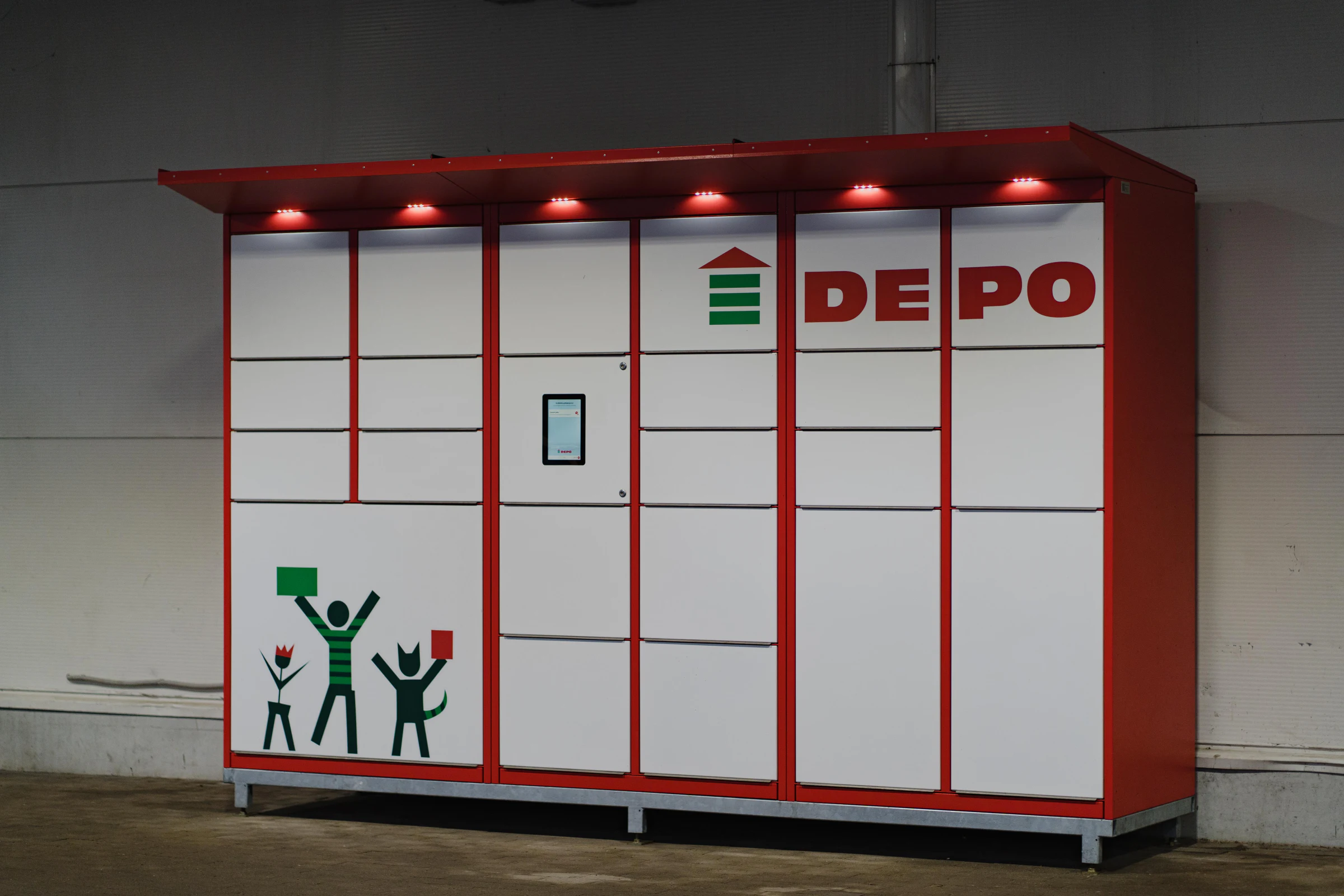
Not long ago, a parcel locker was something you walked past at the supermarket. Today carriers are racing to put one within walking distance of every home. How many are there now, who is building them fastest, and what does it change for a business that hands goods to its customers? This article brings together the latest public figures, with a link to every source.
The short answer
Parcel lockers are the fastest-growing part of out-of-home delivery in Europe. Last Mile Experts counted 184,400 lockers in 32 European countries in its 2025 report, 20% more than a year earlier. InPost alone ran 68,925 lockers at the end of June 2026, up 29% in a year, while its network of staffed pickup points shrank by 16%. For businesses, this means customers increasingly expect to collect at any hour, close to home. Carrier lockers serve standard parcels well. Goods that are large, valuable or need a special handover still call for a pickup point of your own.
How many parcel lockers does Europe have?
The most complete public count comes from Last Mile Experts, a consultancy that maps out-of-home delivery every year. According to its Out-of-Home Delivery in Europe 2025 report, as summarised by GEL Proximity, Europe had 646,480 out-of-home points in 32 countries. Of those, 462,080 were staffed pickup and drop-off points in shops and kiosks (PUDOs in the trade), and 184,400 were automated parcel machines, the industry's name for parcel lockers. The number of lockers grew by 20% in a year.
Poland is in a league of its own:
| Country | Parcel lockers (2025 report) |
|---|---|
| Poland | 45,325 |
| France | 17,510 |
| United Kingdom | 15,565 |
| Ukraine | 13,098 |
| Spain | 10,905 |
Poland's network is also dense: 17.3 out-of-home points for every 10,000 inhabitants.
Who is building the fastest?
InPost, the Polish locker operator, publishes the size of its network every quarter. Its Q2 2026 results of 31 August 2026 show 68,925 lockers across its markets, 29% more than a year before:
- 29,912 in Poland, up 12%
- 23,385 in its eurozone markets, up 52%
- 15,628 in the UK and Ireland, up 41%
Over the same twelve months, InPost's network of staffed pickup points fell by 16%, to 29,281. At InPost at least, the direction is clear: where a carrier can choose, it increasingly chooses a machine over a shop counter.
Poland shows where this leads. In the second quarter of 2026, 146.6 million of InPost's 198.0 million parcels in Poland went to a locker, about 74%. The company says 90% of the urban population and 66% of all Poles have one of its lockers within a seven-minute walk.
Home delivery is not disappearing, though. In the same quarter, InPost's own door-to-door volumes in Poland rose by 46%, to 51.4 million parcels.
Why are carriers moving parcels from doors to lockers?
The economics are simple. A courier who stops at a locker can leave dozens of parcels in one stop, instead of driving to dozens of doors. Nobody has to be home, so the first delivery attempt succeeds, a point a 2021 study in the journal Sustainability makes about lockers in general. And the customer collects when it suits them, rather than waiting in for a delivery slot.
For the carrier, that means fewer kilometres and fewer second attempts per parcel. For the customer, it means a parcel is waiting a short walk away, at any hour.
What is happening in the Baltics?
In the Baltic states, the locker is already the default. Parcel lockers are the most popular delivery method in the region, according to Omniva's 2025 results, which base this on public surveys and the company's own statistics. Omniva delivered 36 million parcels across the three countries in 2025, 11% more than a year earlier. In Latvia it delivered 11.0 million, up 10%. In Lithuania it delivered 15.7 million, also up 10%.
The networks in the cities are dense. In November 2024, Latvian Radio counted almost 400 Omniva lockers in Latvia (about 1,300 across the Baltics), 350 from DPD and 413 from Latvijas Pasts, which had started that year with 250. The operators expected slower growth from then on, because the network was already extensive.
The growth has moved to smaller towns. Omniva planned 400 to 500 lockers for smaller communities in 2026, with the first 150 finished by March.
The market is also consolidating. On 27 July 2026, Deutsche Post DHL Group announced it would buy Venipak, which runs about 800 parcel lockers in the Baltics. Latvian public media reported that the deal was not yet completed, and the head of the Latvian Logistics Association expected users to notice little change beyond the colour of the lockers.
And in the Netherlands?
Dutch consumers are among the most active online shoppers in Europe. According to Eurostat's e-commerce statistics, Ireland (87%) and the Netherlands (86%) had the highest shares of people who had bought online in the previous three months in 2025. Across the EU, 78% of internet users aged 16 to 74 bought online that year, against 62% in 2015.
Lockers arrived later in the Netherlands than in Poland, but the networks are growing quickly. In March 2025, PostNL said it had about 1,100 lockers and would add more than 500 that year, investing €10 million, and that it expected consumers' use of its lockers to double, according to an ANP report.
Are parcel lockers better for the climate?
Often, but not automatically. The 2021 Sustainability study concluded that lockers reduce travelled distances and CO2 emissions only "under certain situations". In practice, the benefit comes from consolidating many parcels into one stop and avoiding failed deliveries. It shrinks when customers make a separate car trip to collect a single parcel. A locker on the walk home, at a station or next to a supermarket the customer visits anyway, keeps the gain.
Recommendation: if you place a locker yourself, put it where your customers already pass, not where there happens to be free space.
What does this mean for your business?
Three things follow from the numbers.
- Customers expect collection at any hour. InPost alone counts 21 million regular locker users in Poland. A business that only hands goods over at a counter between nine and six is asking customers to adapt to it.
- Carrier lockers are built for carriers. They are sized for standard parcels, run on the carrier's software and carry the carrier's brand. That suits a web shop sending small parcels. It suits less well a business whose goods are large, whose handover needs a check, or that wants the customer to come to its own site.
- Your own pickup point is a different product. A locker at your own store, dealership or warehouse brings the customer to you, works with your own systems and takes the sizes you actually hand over.
What we see on site
The lockers we build sit next to the carrier networks, not against them. They handle what a carrier locker can't. At car dealerships they hold car keys handed over before opening time. At an agricultural machinery dealer they hand out spare parts after hours. At JYSK in Riga, Tallinn and Reykjavík they hold sofas and mattresses, which no standard parcel locker would take.
How to choose: a carrier's locker or your own?
- Use a carrier's network when you send standard-sized parcels to customers spread across a country, and the handover needs nothing more than a code.
- Consider your own locker when the goods are large or unusual in shape, when the customer should come to your site, when the handover needs your own process (keys, documents, returns), or when you want the brand, the opening hours and the customer data in your own hands.
- Check the location either way: a locker people pass anyway gets used, and keeps its climate benefit.
- Ask about integration: how the locker reports to your e-shop, ERP or POS, and who monitors it.
Frequently asked questions
How many parcel lockers are there in Europe?
Last Mile Experts' 2025 report counted 184,400 parcel lockers in 32 European countries, alongside 462,080 staffed pickup points. Poland had the most, with 45,325 lockers.
How fast are parcel locker networks growing?
The number of lockers in Europe grew by 20% in a year, according to the same report. InPost's own network grew by 29% between the second quarters of 2025 and 2026, and by 52% in its eurozone markets.
Are parcel lockers replacing home delivery?
Not entirely. In Poland about three in four InPost parcels went to a locker in the second quarter of 2026, but InPost's door-to-door volumes there still grew by 46% in the second quarter of 2026. Lockers are taking share, and home delivery remains.
Are parcel lockers popular in the Baltics?
Yes. Omniva describes them as the most popular delivery method in the Baltic states. Its locker network in Latvia alone had almost 400 machines by late 2024, and DPD, Latvijas Pasts and Venipak run large networks of their own.
Can a company have its own parcel locker?
Yes. Retailers, dealerships, universities and warehouses run lockers of their own for their own goods and customers, next to the carrier networks. Our smart lockers and custom lockers are made for that.
Sources
- Last Mile Experts, Out-of-Home Delivery in Europe 2025, as summarised by GEL Proximity, 4 July 2025
- InPost Group Q2 2026 results, 31 August 2026
- Omniva: record parcel volumes in 2025, 23 January 2026
- Omniva: 2025 results in Lithuania, 4 March 2026
- LSM (Latvian Radio): parcel lockers in Latvia, 25 November 2024
- LSM: the DHL and Venipak deal, 31 July 2026
- Eurostat: e-commerce statistics for individuals, data extracted February 2026
- ANP via nieuws.nl: PostNL adds hundreds of parcel lockers, 3 March 2025
- Prandtstetter et al., On the Impact of Open Parcel Lockers on Traffic, Sustainability 13(2), 2021
Thinking about a pickup point of your own, next to the carrier lockers your customers already use? Contact us.